Showing posts with label Math. Show all posts

Wednesday, July 9, 2014

A quick and dirty intro to ID

This is just a quick and dirty intro to Intelligent Design (ID).

Obviously, I think it'd be best for people to go straight to the source and read about ID directly from websites like Uncommon Descent and Evolution News & Views. To say nothing of the plethora of published works by ID theorists William Dembski, Stephen Meyer, Michael Behe, et al.

However, since I've had friends and others ask me to explain ID, I thought it'd be worth summarizing what I think is the main point of ID to them.


Francis Crick, who co-discovered the structure of DNA along with James Watson, once said:

Biologists must constantly keep in mind that what they see was not designed, but rather evolved.

By the same token, the militant atheist and evolutionist Richard Dawkins has said:

Biology is the study of complicated things that give the appearance of having been designed for a purpose.

As ID theorists have pointed out, the key word is "appearance." Individuals like Dawkins believe living organisms merely "appear" to have been designed when in fact they are anything but. They believe living organisms have instead come into being via unguided and purposeless natural processes. And that these natural processes are best explicated in neo-Darwinism.

By contrast, a reason ID theorists use the term "intelligent" in ID is because they wish to distinguish between an unguided and purposeless natural process vs a guided and purposeful process best explained by intelligent agency.

Now, virtually everyone recognizes there are many things in this universe which look like they're designed. Obviously we know things like computers, cars, and buildings have been engineered by humans. Likewise, various works of art, literature, music, movies, computer games. Similarly, we could say many inorganic materials like various plastics have been artificially designed. We could further include nanoparticles and arguably the synthetic elements in the Periodic Table too. Almost everyone including atheists like Dawkins would probably agree most if not all of these have been designed by intelligent agents i.e. humans.

But when it comes to living organisms, while everyone agrees life looks designed, atheists like Dawkins think actual design is an illusion. (I suppose in some ways similar to how some atheists think of consciousness.)

Worse, they practically become apoplectic if anyone so much as hints the design may not be an illusion but may in fact be actual design by an actual intelligence of some sort. That it may not have been unguided and purposeless after all. Or to put it another, if anyone casts doubt on the neo-Darwinian paradigm.

As an aside, it often seems as if it's all but a thought-crime to question Darwinism. This isn't hyperbolic language for effect, I don't think. There have been very real and unfortunate consequences. For example, many people's reputations have been unfairly marred. Many have lost their jobs and thus livelihoods and/or been blacklisted from future jobs due to their dissent from Darwinism. For starters, check out what happened to Richard Sternberg and Guillermo Gonzalez.

Getting back to the point, given living organisms appear designed, the next logical question should be: are living organisms, in fact, designed? Not: how or by what mechanisms have living organisms come to appear designed? Nor: who or what designed living organisms? (Dawkins, Coyne, Wolpert, and their kind react as equally irked by theistic evolution as they do by ID theory.) Yet neo-Darwinists often get ahead of themselves and confuse and/or conflate these and other questions and their related issues. They proceed, for example, to shout down ID theorists as Young Earth Creationists (YEC) in disguise, even though it's clear to anyone with a modicum of fair-mindedness and an ounce of familiarity with the movement that ID most decidedly is not. (Sometimes to the chagrin of many actual YECs!) Of course, these are good questions to ask, and questions which we should ask. But my immediate point is ID doesn't strictly speaking deal with these questions, not as their first port of call.

So, how can we tell if a living organism is truly designed? This is where intelligence comes in. Indeed, intelligence is what makes the crucial difference between the mere appearance of design vs actual design. In other words, there's a significant distinction between unintelligent design vs intelligent design, for unintelligent design means an unguided and purposeless natural process (i.e. neo-Darwinian theory), while intelligent design is, as I've already noted, the reverse.

Specifically, according to ID theorists, intelligence is a causal power that can arrange and adapt means to bring about teleological ends. This stands in distinction both to brute necessity which does not arrange or adapt means as well as to random chance which is not teleological or goal-oriented.

What's more, ID theorists have come up with ways to detect intelligence. I think Dembski's scheme is the most analytically rigorous. It'd be beyond the scope of this post to go into detail, but Dembski does point out three marks of intelligence: contingency, complexity, and specificity. By contingency he simply means if an object or event is unnecessary or, if you like, optional; if it occurred, even though it need not have occurred. Complexity refers to the fact that an object or event is difficult to reproduce by chance alone. And specificity is if an object or event exhibits an independent pattern. Dembski terms his theory of intelligence detection, specified complexity, and argues only intelligence can originate or generate specified complexity when prior to intelligence there was no specified complexity. Note this isn't the same as unintelligent natural processes making use of specified complexity.

If specified complexity is successful, then at a minimum it means we have sound and reasonable scientific and mathematical criteria to detect intelligent design in nature.

Background to pop gen

Here's some quick and dirty background info for those curious about population genetics. It'll be simplified for wider popular appeal, but hopefully not overly simplified. I won't talk about population genetics itself, per se, since that'd be a bit too time-consuming for me to provide right now. But the background should provide enough knowledge to get people started on learning about population genetics on their own.

1. DNA. The first thing to know is that we're made up of DNA. DNA is a molecule that resides in us and encodes all our genetic information. We can think of it as containing all the instructions for how to make a human being.

2. Genes. DNA is composed of genes. Genes are segments of DNA that give humans form and/or function. Genes are also passed on from one parent to their child.

3. Allele. An allele is an alternative form of a gene. A variant. For example, different eye colors (e.g. blue, brown).

4. Genome. A person's genome is all the genetic info in a single person. This is all the DNA in a person.

Usually when we refer to DNA, we're talking about the DNA in a person's chromosomes aka chromosomal DNA. But there's also what's called mitochondrial DNA. That is, DNA in a person's mitochondria as well.

There are further distinctions but this should suffice for our purposes.

At any rate, a person's genome would include all the DNA.

5. Population. A population is all the organisms in a given set that can interbreed with one another. Actually, this is a very basic definition. It isn't perfect by any means, and debatable. But we'll just stick with this for now.

6. Evolution. A basic definition of evolution is a change in the frequencies of genes/alleles in a given population. Again, somewhat debatable, or at least requiring more elaboration, but we'll move on.

7. According to neo-Darwinian evolutionary theory, there are at least five factors that can influence the frequency of the genes/alleles in a population:

a. Natural selection. This is based on fitness. This is when the fitter or fittest individuals of a population survive (e.g. thick coated foxes are more fit to survive in the Arctic than thin coated foxes), pass on their genes/alleles, and thus their genes/alleles become more frequent in a population.

b. Sexual selection. This is based on sexual attractiveness. This is when the more sexually attractive individuals of a population mate and have the most offspring, thus passing on their genes/alleles, and thus their genes/alleles become more frequent in a population.

c. Gene migration. This is based on movement. This is when new individuals with new genes/alleles migrate into or out of another population, thus changing the frequency of genes/alleles in a population.

d. Genetic drift. This is based on chance. This is when random chance events (e.g. bugs getting stepped on, floods wiping out half the population) lead to changes in the frequency of genes/alleles in a population.

e. Mutations. This is based on anomalies in the genetic code. This is when mistakes in DNA lead to new genes/alleles.

7. Equilibrium. Specifically, Hardy-Weinberg equilibrium. A population is said to be in (Hardy-Weinberg) equilibrium when none of the previously mentioned factors are in operation. It also assumes all individuals in a given population capable of breeding are breeding and each produces the same number of offspring.

That is, natural selection is not at work. Sexual selection is completely random. There are no new migrants into or out of a population. There is a huge population size in order to moot random chance events affecting the frequency of genes/alleles in a population. Finally, no mutations ever occur.

8. Finally, as the cornerstone of population genetics, we have what's called the Hardy-Weinberg equation. The equation is: p2 + 2pq + q2 = 1.

We can think the equation in the following way.

Consider three basic types of genes/alleles. Say we have XX genes/alles representing dominant genes/alleles, xx representing recessive genes/alleles, and Xx representing mixed dominant and recessive genes/alleles.

Accordingly, the "p2" in the equation refers to what's called homozygous dominant genes/alleles. The "q2" refers to what's called homozygous recessive genes/alleles. And the "2pq" refers to what's called heterozygous genes/alleles.

If we know 40% of a given population posses homozygous dominant genes/alleles, then we know p2 = 0.4.

If p2 = 0.4, then p = 0.63 (approx).

That means q = 1 - 0.63 = 0.37.

While q2 = 0.137.

And 2pq = 0.466.

Thus, since we know p2 = 0.4, 2pq = 0.466, and q2 = 0.137, then we know 40% of the population possesses homozygous dominant genes (e.g. XX), 46.6% of the population possesses heterozygous genes/alles (e.g. Xx), and 13.7% of the population possesses homozygous recessive genes/alleles.

Bayesian statistics

I'm familiar with general statistics, but I'm no expert in Bayesian statistics. So perhaps I'm mistaken in what I'm about to say.

Also, I should say, I'm by no means against the use of Bayesian statistics. In fact, I think it has great value in certain apologetic contexts.

However, isn't one limitation of Bayesian statistics the presumption that the Bayesian statistician is able to assess the probabilities of a particular theory from a completely objective, impartial, and almost omniscient sort of a perspective or standpoint? As if one could comprehensively evaluate a theory on its own merits or demerits, as well as any and all unknown variables in or related to the theory?

But in practice, isn't it more often the case that one has to assess the probabilities of a particular theory in relation to competing theories?

Saturday, January 11, 2014

Fractal dimensions

Let's talk about fractal dimensions. Just for fun.

1. As many know, fractals are a type of geometric object which consists of self-similar patterns on all scales of magnification.

2. What's not as often discussed is fractal dimensions.

a. We know a point has zero dimensions. A line has one dimension (length). A square has two dimensions (length, width). A cube has three dimensions (length, width, depth). Likewise, fractals have fractal dimension.

b. An example that's sometimes used to illustrate fractal dimension is the Sierpinski triangle. What is a Sierpinski triangle?

Start with an equilateral triangle:

Cut out a central triangle as follows:

Next, cut out three smaller triangles as follows:

And then repeat for each of the triangles that haven't been cut out as follows:

If we continue, the result will be a Sierpinski triangle like this one:

c. Normally, if we double the lengths of a triangle, its area will be quadrupled. Say we have a triangle with base 2 and height 3. Its area would be (2 x 3) / 2 = 3. If we double its base and height, then we would have (4 x 6) / 2 = 12. And 12 is 4x greater than 3.

d. Strangely, though, if we double the lengths of a Sierpinski triangle, its area will not be quadrupled. Instead, its area will only be tripled.

This is due to the fact that when we take three smaller Sierpinski triangles to form a larger Sierpinski triangle, the larger Sierpinski triangle has doubled in size.

Thus, the Sierpinski triangle has a dimension = log 3 / log 2. That is, approximately 1.585 dimensions (if we round up).

How can we have 1.585 dimensions though? Since we cut out triangles within triangles over and over again, and in fact we could do so an infinite number of times, the resulting Sierpinski triangle is more like an assembly of points (with zero dimensions) or a grid of lines (with 1 dimension). Hence overall the Sierpinski triangle isn't 2 dimensional like a normal triangle would be, but it has 1.585 dimensions.

e. BTW, Sierpinski triangles can also be Sierpinski pyramids:

3. A few further notes:

a. In reality, a dimension either is or isn't. We can't have partial dimensions. Thus, 1.585 (or whatever) dimensions is not reality, per se, but a mathematical abstraction.

b. That said, say we have a piece of string. Say we assume this string is 1 dimensional. (Of course, all physical objects in our universe are actually at least three dimensional.) Say it's a long piece of string. Say we roll this string up so it becomes a ball. As such, the originally 1 dimensional string has become in a sense 3 dimensional.

Take another example. Say we assume a piece of paper is 2 dimensional. Say we crumple up this piece of paper. As such, the originally 2 dimensional piece of paper is 3 dimensional.

Fractals can likewise be "crumpled," so to speak.

c. Of course, the real universe in which we live is 3+1 dimensions. That is, 3 space dimensions + 1 time dimension.

We can use fractals and fractal dimensions to better understand our own world. There's a lifetime of study in this alone.

However, perhaps we can likewise use fractals and fractal dimensions to help us imagine worlds beyond our own? That is, like Edwin Abbott did in Flatland, or Ian Stewart did in Flatterland, it's possible to imagine that we live in 4+1 dimensions, for example. Perhaps fractals and fractal dimensions can be an aid here.

I'd like to write more about this in the future, time permitting.

Tuesday, February 7, 2012

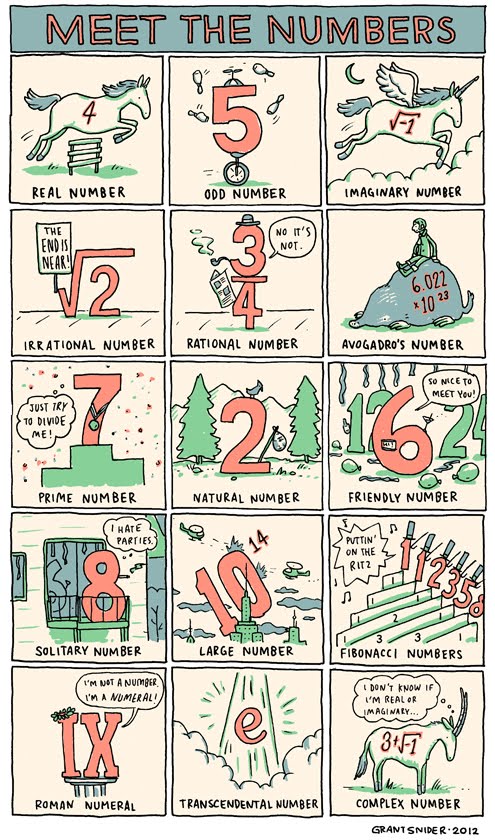
Meet the numbers


(Although I can chuckle at it, the only depiction I'm not too terribly amused about is irrational number.)

Friday, January 27, 2012

William Dembski interview


An informative interview with William Dembski. It's mainly about the course of his life including his pioneering work in Intelligent Design.

HT: Steve Hays.
Showing posts with label Math. Show all posts

Wednesday, July 9, 2014

A quick and dirty intro to ID

This is just a quick and dirty intro to Intelligent Design (ID).

Obviously, I think it'd be best for people to go straight to the source and read about ID directly from websites like Uncommon Descent and Evolution News & Views. To say nothing of the plethora of published works by ID theorists William Dembski, Stephen Meyer, Michael Behe, et al.

However, since I've had friends and others ask me to explain ID, I thought it'd be worth summarizing what I think is the main point of ID to them.


Francis Crick, who co-discovered the structure of DNA along with James Watson, once said:

Biologists must constantly keep in mind that what they see was not designed, but rather evolved.

By the same token, the militant atheist and evolutionist Richard Dawkins has said:

Biology is the study of complicated things that give the appearance of having been designed for a purpose.

As ID theorists have pointed out, the key word is "appearance." Individuals like Dawkins believe living organisms merely "appear" to have been designed when in fact they are anything but. They believe living organisms have instead come into being via unguided and purposeless natural processes. And that these natural processes are best explicated in neo-Darwinism.

By contrast, a reason ID theorists use the term "intelligent" in ID is because they wish to distinguish between an unguided and purposeless natural process vs a guided and purposeful process best explained by intelligent agency.

Now, virtually everyone recognizes there are many things in this universe which look like they're designed. Obviously we know things like computers, cars, and buildings have been engineered by humans. Likewise, various works of art, literature, music, movies, computer games. Similarly, we could say many inorganic materials like various plastics have been artificially designed. We could further include nanoparticles and arguably the synthetic elements in the Periodic Table too. Almost everyone including atheists like Dawkins would probably agree most if not all of these have been designed by intelligent agents i.e. humans.

But when it comes to living organisms, while everyone agrees life looks designed, atheists like Dawkins think actual design is an illusion. (I suppose in some ways similar to how some atheists think of consciousness.)

Worse, they practically become apoplectic if anyone so much as hints the design may not be an illusion but may in fact be actual design by an actual intelligence of some sort. That it may not have been unguided and purposeless after all. Or to put it another, if anyone casts doubt on the neo-Darwinian paradigm.

As an aside, it often seems as if it's all but a thought-crime to question Darwinism. This isn't hyperbolic language for effect, I don't think. There have been very real and unfortunate consequences. For example, many people's reputations have been unfairly marred. Many have lost their jobs and thus livelihoods and/or been blacklisted from future jobs due to their dissent from Darwinism. For starters, check out what happened to Richard Sternberg and Guillermo Gonzalez.

Getting back to the point, given living organisms appear designed, the next logical question should be: are living organisms, in fact, designed? Not: how or by what mechanisms have living organisms come to appear designed? Nor: who or what designed living organisms? (Dawkins, Coyne, Wolpert, and their kind react as equally irked by theistic evolution as they do by ID theory.) Yet neo-Darwinists often get ahead of themselves and confuse and/or conflate these and other questions and their related issues. They proceed, for example, to shout down ID theorists as Young Earth Creationists (YEC) in disguise, even though it's clear to anyone with a modicum of fair-mindedness and an ounce of familiarity with the movement that ID most decidedly is not. (Sometimes to the chagrin of many actual YECs!) Of course, these are good questions to ask, and questions which we should ask. But my immediate point is ID doesn't strictly speaking deal with these questions, not as their first port of call.

So, how can we tell if a living organism is truly designed? This is where intelligence comes in. Indeed, intelligence is what makes the crucial difference between the mere appearance of design vs actual design. In other words, there's a significant distinction between unintelligent design vs intelligent design, for unintelligent design means an unguided and purposeless natural process (i.e. neo-Darwinian theory), while intelligent design is, as I've already noted, the reverse.

Specifically, according to ID theorists, intelligence is a causal power that can arrange and adapt means to bring about teleological ends. This stands in distinction both to brute necessity which does not arrange or adapt means as well as to random chance which is not teleological or goal-oriented.

What's more, ID theorists have come up with ways to detect intelligence. I think Dembski's scheme is the most analytically rigorous. It'd be beyond the scope of this post to go into detail, but Dembski does point out three marks of intelligence: contingency, complexity, and specificity. By contingency he simply means if an object or event is unnecessary or, if you like, optional; if it occurred, even though it need not have occurred. Complexity refers to the fact that an object or event is difficult to reproduce by chance alone. And specificity is if an object or event exhibits an independent pattern. Dembski terms his theory of intelligence detection, specified complexity, and argues only intelligence can originate or generate specified complexity when prior to intelligence there was no specified complexity. Note this isn't the same as unintelligent natural processes making use of specified complexity.

If specified complexity is successful, then at a minimum it means we have sound and reasonable scientific and mathematical criteria to detect intelligent design in nature.

Background to pop gen

Here's some quick and dirty background info for those curious about population genetics. It'll be simplified for wider popular appeal, but hopefully not overly simplified. I won't talk about population genetics itself, per se, since that'd be a bit too time-consuming for me to provide right now. But the background should provide enough knowledge to get people started on learning about population genetics on their own.

1. DNA. The first thing to know is that we're made up of DNA. DNA is a molecule that resides in us and encodes all our genetic information. We can think of it as containing all the instructions for how to make a human being.

2. Genes. DNA is composed of genes. Genes are segments of DNA that give humans form and/or function. Genes are also passed on from one parent to their child.

3. Allele. An allele is an alternative form of a gene. A variant. For example, different eye colors (e.g. blue, brown).

4. Genome. A person's genome is all the genetic info in a single person. This is all the DNA in a person.

Usually when we refer to DNA, we're talking about the DNA in a person's chromosomes aka chromosomal DNA. But there's also what's called mitochondrial DNA. That is, DNA in a person's mitochondria as well.

There are further distinctions but this should suffice for our purposes.

At any rate, a person's genome would include all the DNA.

5. Population. A population is all the organisms in a given set that can interbreed with one another. Actually, this is a very basic definition. It isn't perfect by any means, and debatable. But we'll just stick with this for now.

6. Evolution. A basic definition of evolution is a change in the frequencies of genes/alleles in a given population. Again, somewhat debatable, or at least requiring more elaboration, but we'll move on.

7. According to neo-Darwinian evolutionary theory, there are at least five factors that can influence the frequency of the genes/alleles in a population:

a. Natural selection. This is based on fitness. This is when the fitter or fittest individuals of a population survive (e.g. thick coated foxes are more fit to survive in the Arctic than thin coated foxes), pass on their genes/alleles, and thus their genes/alleles become more frequent in a population.

b. Sexual selection. This is based on sexual attractiveness. This is when the more sexually attractive individuals of a population mate and have the most offspring, thus passing on their genes/alleles, and thus their genes/alleles become more frequent in a population.

c. Gene migration. This is based on movement. This is when new individuals with new genes/alleles migrate into or out of another population, thus changing the frequency of genes/alleles in a population.

d. Genetic drift. This is based on chance. This is when random chance events (e.g. bugs getting stepped on, floods wiping out half the population) lead to changes in the frequency of genes/alleles in a population.

e. Mutations. This is based on anomalies in the genetic code. This is when mistakes in DNA lead to new genes/alleles.

7. Equilibrium. Specifically, Hardy-Weinberg equilibrium. A population is said to be in (Hardy-Weinberg) equilibrium when none of the previously mentioned factors are in operation. It also assumes all individuals in a given population capable of breeding are breeding and each produces the same number of offspring.

That is, natural selection is not at work. Sexual selection is completely random. There are no new migrants into or out of a population. There is a huge population size in order to moot random chance events affecting the frequency of genes/alleles in a population. Finally, no mutations ever occur.

8. Finally, as the cornerstone of population genetics, we have what's called the Hardy-Weinberg equation. The equation is: p2 + 2pq + q2 = 1.

We can think the equation in the following way.

Consider three basic types of genes/alleles. Say we have XX genes/alles representing dominant genes/alleles, xx representing recessive genes/alleles, and Xx representing mixed dominant and recessive genes/alleles.

Accordingly, the "p2" in the equation refers to what's called homozygous dominant genes/alleles. The "q2" refers to what's called homozygous recessive genes/alleles. And the "2pq" refers to what's called heterozygous genes/alleles.

If we know 40% of a given population posses homozygous dominant genes/alleles, then we know p2 = 0.4.

If p2 = 0.4, then p = 0.63 (approx).

That means q = 1 - 0.63 = 0.37.

While q2 = 0.137.

And 2pq = 0.466.

Thus, since we know p2 = 0.4, 2pq = 0.466, and q2 = 0.137, then we know 40% of the population possesses homozygous dominant genes (e.g. XX), 46.6% of the population possesses heterozygous genes/alles (e.g. Xx), and 13.7% of the population possesses homozygous recessive genes/alleles.

Bayesian statistics

I'm familiar with general statistics, but I'm no expert in Bayesian statistics. So perhaps I'm mistaken in what I'm about to say.

Also, I should say, I'm by no means against the use of Bayesian statistics. In fact, I think it has great value in certain apologetic contexts.

However, isn't one limitation of Bayesian statistics the presumption that the Bayesian statistician is able to assess the probabilities of a particular theory from a completely objective, impartial, and almost omniscient sort of a perspective or standpoint? As if one could comprehensively evaluate a theory on its own merits or demerits, as well as any and all unknown variables in or related to the theory?

But in practice, isn't it more often the case that one has to assess the probabilities of a particular theory in relation to competing theories?

Saturday, January 11, 2014

Fractal dimensions

Let's talk about fractal dimensions. Just for fun.

1. As many know, fractals are a type of geometric object which consists of self-similar patterns on all scales of magnification.

2. What's not as often discussed is fractal dimensions.

a. We know a point has zero dimensions. A line has one dimension (length). A square has two dimensions (length, width). A cube has three dimensions (length, width, depth). Likewise, fractals have fractal dimension.

b. An example that's sometimes used to illustrate fractal dimension is the Sierpinski triangle. What is a Sierpinski triangle?

Start with an equilateral triangle:

Cut out a central triangle as follows:

Next, cut out three smaller triangles as follows:

And then repeat for each of the triangles that haven't been cut out as follows:

If we continue, the result will be a Sierpinski triangle like this one:

c. Normally, if we double the lengths of a triangle, its area will be quadrupled. Say we have a triangle with base 2 and height 3. Its area would be (2 x 3) / 2 = 3. If we double its base and height, then we would have (4 x 6) / 2 = 12. And 12 is 4x greater than 3.

d. Strangely, though, if we double the lengths of a Sierpinski triangle, its area will not be quadrupled. Instead, its area will only be tripled.

This is due to the fact that when we take three smaller Sierpinski triangles to form a larger Sierpinski triangle, the larger Sierpinski triangle has doubled in size.

Thus, the Sierpinski triangle has a dimension = log 3 / log 2. That is, approximately 1.585 dimensions (if we round up).

How can we have 1.585 dimensions though? Since we cut out triangles within triangles over and over again, and in fact we could do so an infinite number of times, the resulting Sierpinski triangle is more like an assembly of points (with zero dimensions) or a grid of lines (with 1 dimension). Hence overall the Sierpinski triangle isn't 2 dimensional like a normal triangle would be, but it has 1.585 dimensions.

e. BTW, Sierpinski triangles can also be Sierpinski pyramids:

3. A few further notes:

a. In reality, a dimension either is or isn't. We can't have partial dimensions. Thus, 1.585 (or whatever) dimensions is not reality, per se, but a mathematical abstraction.

b. That said, say we have a piece of string. Say we assume this string is 1 dimensional. (Of course, all physical objects in our universe are actually at least three dimensional.) Say it's a long piece of string. Say we roll this string up so it becomes a ball. As such, the originally 1 dimensional string has become in a sense 3 dimensional.

Take another example. Say we assume a piece of paper is 2 dimensional. Say we crumple up this piece of paper. As such, the originally 2 dimensional piece of paper is 3 dimensional.

Fractals can likewise be "crumpled," so to speak.

c. Of course, the real universe in which we live is 3+1 dimensions. That is, 3 space dimensions + 1 time dimension.

We can use fractals and fractal dimensions to better understand our own world. There's a lifetime of study in this alone.

However, perhaps we can likewise use fractals and fractal dimensions to help us imagine worlds beyond our own? That is, like Edwin Abbott did in Flatland, or Ian Stewart did in Flatterland, it's possible to imagine that we live in 4+1 dimensions, for example. Perhaps fractals and fractal dimensions can be an aid here.

I'd like to write more about this in the future, time permitting.

Friday, November 15, 2013

Friday, April 6, 2012

Monday, February 20, 2012

Tuesday, February 7, 2012

Meet the numbers


(Although I can chuckle at it, the only depiction I'm not too terribly amused about is irrational number.)

Monday, February 6, 2012

Thursday, February 2, 2012

Friday, January 27, 2012

William Dembski interview


An informative interview with William Dembski. It's mainly about the course of his life including his pioneering work in Intelligent Design.

HT: Steve Hays.

Tuesday, January 3, 2012